Flexi-Cap Funds Explained: How Flexible Equity Allocation Works Across Market Caps
Choosing an equity mutual fund is not only about looking at past returns. The fund’s investment mandate matters too. While some equity funds focus on large, mid or small-cap stocks, a flexi-cap fund can move across all three segments without a prescribed minimum allocation to each market-cap category.
Understanding this structure can help investors assess whether a flexi-cap fund fits their investment goals and risk tolerance.
Flexi Cap Fund Meaning: What Does It Actually Mean?
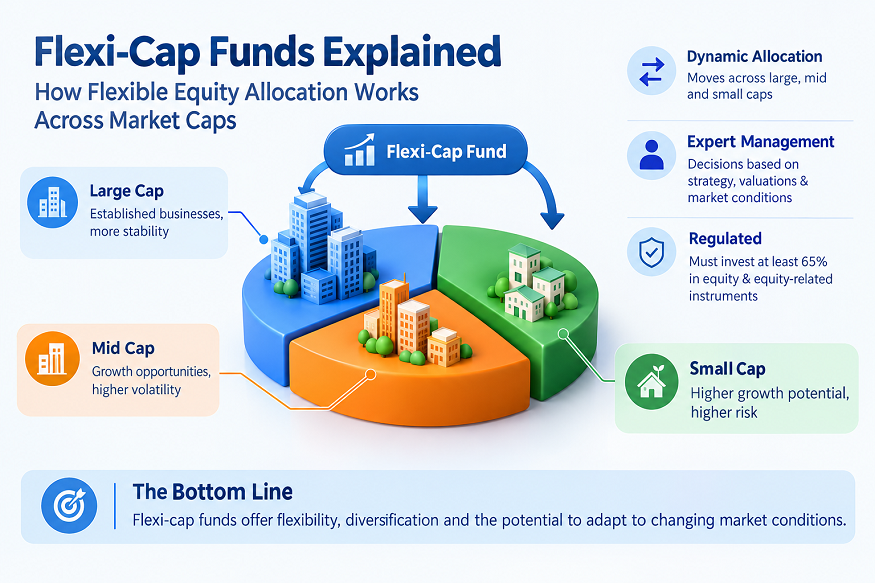
Under SEBI’s current mutual fund categorisation, the flexi cap fund meaning is fairly straightforward. A Flexi Cap Fund is an open-ended dynamic equity scheme investing across large-cap, mid-cap and small-cap stocks. It must invest at least 65% of total assets in equity and equity-related instruments.
Unlike a fund with a fixed market-cap allocation, a flexi-cap fund does not have to maintain a set split between large, mid and small caps. The allocation can change based on the fund’s strategy, valuations, business prospects and market conditions. This flexibility is the defining feature of the category.
Large Cap, Mid Cap and Small Cap: A Quick Refresher
Under the current SEBI/AMFI classification framework, large-cap companies are ranked from 1st to 100th, mid-cap companies from 101st to 250th, and small-cap companies from 251st onwards based on full market capitalisation.
Large-cap companies are generally more established, while mid- and small-cap companies can offer greater growth opportunities but may also experience higher volatility. These classifications do not guarantee safety or returns. Any equity segment can perform differently across market cycles.
How Does Flexible Equity Allocation Work?
This is where a flexi cap mutual fund differs from more narrowly defined equity categories.
Imagine a hypothetical ₹10 lakh portfolio with ₹7 lakh in large-cap stocks, ₹2 lakh in mid-cap stocks and ₹1 lakh in small-cap stocks. This is only an illustration and not a recommended allocation.
If the fund manager later sees better risk-reward opportunities among mid-cap companies, the portfolio may increase its mid-cap exposure while reducing another segment, subject to the scheme’s mandate and applicable regulations.
The key benefit is that investors do not have to make every market-cap allocation decision themselves. However, flexibility does not mean unlimited freedom. The fund must continue to follow its stated investment mandate and regulatory requirements.
What Is Flexi Cap in Mutual Fund Investing Compared With Other Equity Funds?
A large-cap fund has a large-cap-oriented mandate, while mid-cap and small-cap funds focus predominantly on their respective segments. A flexi-cap fund, on the other hand, can allocate across all three.
This can be useful for investors who want exposure to different parts of the equity market without separately selecting large-, mid- and small-cap schemes. However, two flexi-cap funds can have very different portfolios because their investment strategies, stock selection and allocation decisions may differ.
How Can Market Conditions Affect a Flexi-Cap Fund?
If large-cap valuations become relatively attractive, a fund manager may increase exposure to established companies. If mid- or small-cap businesses offer attractive long-term opportunities, exposure to those segments may increase.
This flexibility can influence the flexi cap fund return over different market cycles, but it does not guarantee superior performance. Returns depend on factors such as stock selection, portfolio allocation, valuations, business performance, market conditions, expenses and the timing of an investor’s purchase or redemption.
Past performance should therefore be treated as historical information and not as an indication of future returns.
Why Do Investors Consider Flexi-Cap Funds?
The main attraction is portfolio flexibility. Potential advantages include:
- Diversification across market caps: Exposure can span companies of different sizes.
- Managerial flexibility: The fund manager can change the portfolio mix as the investment strategy evolves.
- One-fund approach: Investors can obtain exposure across market-cap segments within a single scheme.
These are structural characteristics, not promises of better returns.
What Are the Risks?
Flexi-cap funds remain equity-oriented investments and can experience substantial fluctuations in value. Diversification across market caps does not make a fund low-risk. A broad market decline can affect the entire portfolio, while mid- and small-cap exposure may add volatility.
There is also fund-manager risk, as different managers may respond differently to the same market conditions. Investors should therefore review the Risk-o-meter, portfolio, investment strategy and expenses rather than relying only on the fund category.
How Should You Evaluate a Flexi-Cap Fund?
Instead of selecting a scheme solely because of a high recent return, consider:
- Investment objective and strategy – Understand how the fund selects and allocates investments.
- Portfolio composition – Review current large-, mid- and small-cap exposure.
- Consistency – Look at performance across multiple market cycles.
- Risk profile – Examine the Risk-o-meter and portfolio concentration.
- Fund expenses – Consider the applicable expense ratio and its effect on returns.
- Fund manager and AMC – Review the investment team and consistency of the strategy.
- Your own horizon and risk tolerance – Ensure the fund suits your financial goals.
Taxation of Flexi-Cap Funds
Flexi-cap funds generally meet the 65% equity threshold relevant to equity-oriented fund taxation. For qualifying equity-oriented mutual fund units, the applicable tax treatment depends on the holding period, transaction date and prevailing tax rules.
Investors should check the latest Income Tax Department guidance and scheme documents before investing or redeeming.
Is a Flexi-Cap Fund Right for You?
A flexi-cap fund may be worth evaluating if you want equity exposure across different market-cap segments and prefer to leave allocation decisions to a professional fund manager.
It may be less suitable if you need predictable returns, have a short investment horizon or cannot tolerate significant fluctuations in portfolio value.
The better question is not simply, “What is the highest flexi cap fund return?” Instead, consider whether the fund’s strategy, risk level and portfolio construction fit your financial goal and ability to withstand market volatility.
Final Takeaway
The key to understanding the flexi cap fund meaning is flexibility, not guaranteed performance. A flexi-cap fund gives the fund manager room to allocate across large-, mid- and small-cap companies while maintaining the category’s minimum equity requirement.
Before investing, read the scheme’s latest Scheme Information Document, review its current portfolio and Risk-o-meter, understand the costs and taxation, and assess whether the investment matches your financial goal and risk tolerance.
Mutual Fund investments are subject to market risks, read all scheme-related documents carefully before investing. The information in this article is for educational purposes only and should not be construed as investment advice, a recommendation, or a guarantee of returns.