Why Commercial Planning Needs a Connected Data and Planning Architecture
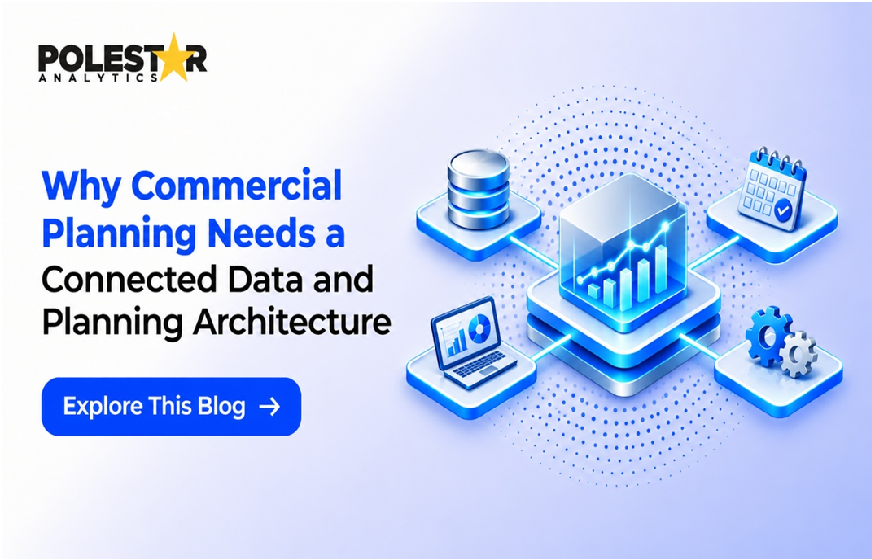
Connected planning architecture for CPG is mostly plumbing. Pricing, promo, demand and finance all pull from one data layer, and quit arguing.
Over half of consumer products executives expect trade policy to force price increases. And 52% worry those increases will cost them volume or share, according to Deloitte’s 2026 Consumer Products Industry Global Outlook.
Underneath that worry sits a planning problem. A price move changes promo depth. Promo depth changes the volume forecast. The forecast changes what finance books as net revenue.
Trouble is, those numbers usually sit in different systems. Different owners too, and different refresh dates. Then a price gets approved off an old forecast. You find out in the gross-to-net. Usually late.
What breaks when CPG commercial planning runs on disconnected data?
Funny thing is that the models are usually decent. Taken one at a time.
Symptoms worth checking for:
- CPG revenue growth management prices on one elasticity read, trade uses another
- Demand baselines treat promo lift differently from the RGM team’s baseline
- Finance reconciles gross-to-net weeks after the promotion has already run
- Account teams bring numbers to joint business planning that retailers can contest
That last one is getting expensive. Deloitte’s survey has a number for it: 79% of CPG execs think power’s moving toward retailers. Fair enough, retailers sit on the shopper data. Walk into a JBP with a baseline they can pick apart, and you’ll lose that argument most times.
Read More: Flexi-Cap Funds Explained: How Flexible Equity Allocation Works Across Market Caps
What does a connected data and planning architecture for CPG include?
Here’s how I’d stack it, four layers, bottom up:
- A data foundation where shipments, sell-out, POS, trade spend and cost land once. This is where the CPG data integration effort goes.
- Shared definitions. Yeah, it’s the boring one. Pick one baseline. Pick one gross-to-net waterfall. Then make commercial and finance both sign the SKU-to-customer hierarchy, in ink.
- The intelligence layer. Models on top: elasticity, incrementality and cannibalisation, run down at SKU and account level where the real calls get made.
- Then the planning layer. It reads from the intelligence layer and (this is the bit people skip) writes the approved plan back, so next cycle starts from it.
Integrated business planning for CPG then runs on the same numbers commercial teams used. Gartner’s February 2026 research on IBP argues that bringing commercial insight into IBP, or at least S&OP, is no longer optional.
Skip the shared definitions and the other three still get built. They just produce four confident answers.
Why does AI-driven commercial planning stall without connected data?
Because an agent recommending promo depth needs the same baseline finance will later use to judge it. Without that, you’ve automated the disagreement.
The money’s been spent, mind you. Gartner asked 243 senior planning leaders, and 83% had already put $3 million or more into automating supply chain planning (September 2026). Yet Gartner reckons just 5% of organisations will let AI make even a tenth of planning calls on its own by 2030. Data quality keeps coming up. So does fuzzy decision ownership. Their analyst was blunt about it: “investment alone does not create AI readiness.”
Confidence is running ahead too. Deloitte found 64% of CPG executives believe they’re ahead of competitors on agentic AI, which the report’s own authors note can’t be true for everyone.
Where should data-driven commercial planning start?
- Pick one decision, say promo depth for a top-five account, before picking a system
- Agree baseline and gross-to-net logic with finance before touching models
- Wire the planning tool to the intelligence layer in both directions
- Judge success on whether the plan held at account level
Gartner says much the same, by the way. Start from the decision. Then check whether decisions actually got better, and don’t count tools that went live.
Read More: Building Scalable Enterprise IT Teams Without Increasing Permanent Headcount
How Polestar Analytics builds connected commercial planning
Full disclosure, this is the work we do at Polestar Analytics, so here’s how we’d wire it. Foundation Studio builds the data estate on Databricks, Microsoft Fabric or Snowflake, whichever you’ve already got. PricePulse handles elasticity down to SKU, geography and channel. PromoPulse measures promo uplift net of baseline.
We’re a preferred AI delivery partner for Anaplan, so those recommendations flow into Anaplan and become a committed plan. One global plant-based food company we worked with went from manual silos to connected trade promotion planning with full gross-to-net visibility.
Connected Commercial Planning: Questions CPG Planning Leaders Ask Next
Do we have to replace our TPM or IBP tools to get connected commercial planning?
Usually not. The fix lives underneath them, in the data and the definitions. Bolt a new tool onto a baseline nobody agrees on, and you’ve just bought the same argument twice.
Our RGM, CPG demand planning and finance teams all want to own the baseline. Who gets it?
Split it. Finance owns gross-to-net and what counts as incremental. RGM owns the models that estimate it. Demand planning uses the output and shouts when it drifts from actual shipments.
Is our consumer packaged goods analytics ready to feed AI agents yet?
Quick test. Take one promo from last quarter and have commercial, finance and supply chain each work out the incremental volume, separately. Same answer? You’re close. Three answers? Sort that out first, before an agent goes anywhere near the plan.